

Contents
- 1 The Holidays Test Every Co-Parenting Plan
- 2 1. Read Your Custody Order Now, Not on December 23
- 3 2. No Custody Order Yet? Make a Plan in Writing
- 4 3. Communicate Early and in Writing
- 5 4. Plan Holiday Travel Carefully
- 6 5. Keep the Focus on Your Child
- 7 6. When Things Go Wrong
- 8 Your Holiday Co-Parenting Checklist
- 9 Getting Help
The Holidays Test Every Co-Parenting Plan
The holiday season is when even well-functioning co-parenting arrangements come under strain. School breaks change the routine, extended family has expectations, travel complicates exchanges, and emotions run high. Disputes that start in December often show up in court in January.
The good news is that most holiday conflict is preventable. A little planning now, a clear understanding of your custody order, and a few communication habits can protect your time with your child and keep the season focused on what matters.
1. Read Your Custody Order Now, Not on December 23
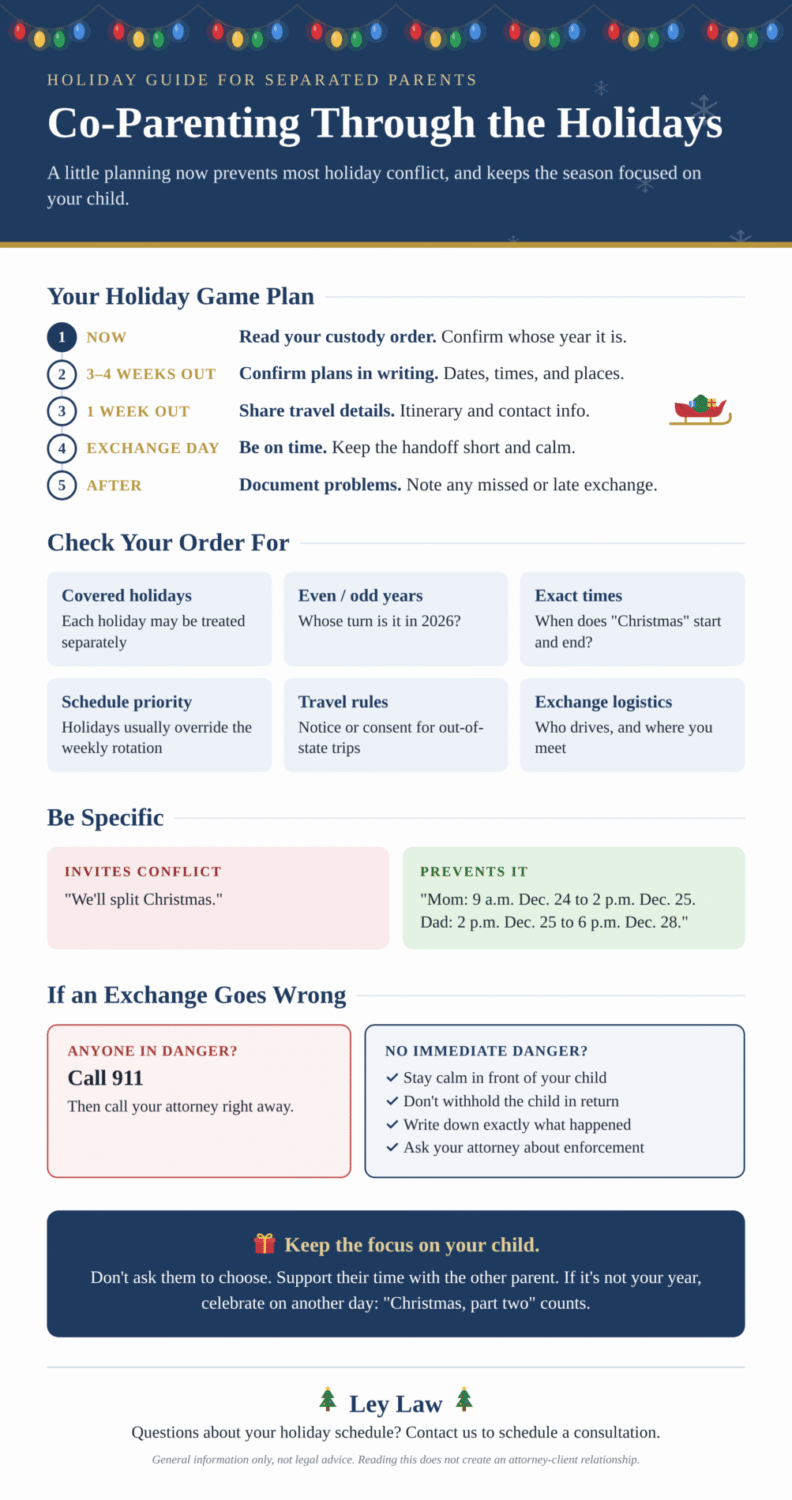
If you have a custody order or a parenting agreement, pull it out this week and read the holiday section carefully. Many disputes happen because one or both parents remember the schedule differently than it is actually written.
Look for:
| What to check | Why it matters |
|---|---|
| Which holidays are covered | Thanksgiving, Christmas Eve, Christmas Day, New Year’s, and winter break may each be handled separately. |
| Even and odd years | Many orders alternate holidays by year. Confirm whose turn it is in 2026. |
| Exact start and end times | “Christmas” might mean noon December 24 to noon December 25, or the first half of winter break. The wording controls. |
| Holiday vs. regular schedule | Most orders give holiday time priority over the weekly rotation, but check yours. |
| Travel and notice rules | Some orders require notice, an itinerary, or consent before out-of-state travel. |
| Exchange logistics | Who picks up, who drops off, and where. |
If something in your order is unclear, talk to your attorney now. There is far more time to clarify it in November than the day before an exchange.
2. No Custody Order Yet? Make a Plan in Writing
If you and the other parent are separated but don’t have a court order, there is no enforceable holiday schedule. Either parent can keep the child, and the court has no order to enforce. That uncertainty is what makes holidays so tense for separated families.
- Agree on a plan early and put it in writing, even if it’s just a text or email exchange that confirms dates, times, and locations.
- Be specific. “We’ll split Christmas” invites conflict. “Mom has the children from 9:00 a.m. December 24 until 2:00 p.m. December 25; Dad has them from 2:00 p.m. December 25 until 6:00 p.m. December 28” does not.
- Think beyond this year. If holidays keep turning into disputes, it may be time to talk with an attorney about a custody agreement or order that sets a long-term holiday schedule.
| Invites conflict | Prevents it |
|---|---|
| “We’ll split Christmas.” | “Mom has the kids 9:00 a.m. Dec. 24 to 2:00 p.m. Dec. 25; Dad has them 2:00 p.m. Dec. 25 to 6:00 p.m. Dec. 28.” |
| “Drop them off after lunch.” | “Exchange at 1:00 p.m. at the Food Lion parking lot on Main Street.” |
| “We’ll figure out New Year’s later.” | “Dad has New Year’s Eve this year; Mom has it next year.” |
An informal agreement can’t be enforced like a court order, but a written record of what you agreed to can still matter later.
3. Communicate Early and in Writing
The best time to confirm holiday plans is weeks ahead, not the night before.
- Confirm the details in writing. Send a short message confirming exchange dates, times, and locations, even if they’re already in your order. If the other parent agrees, you both have a clear record.
- Use a co-parenting app if you have one. Apps like OurFamilyWizard and TalkingParents timestamp every message and keep a shared calendar.
- Coordinate gifts. Agree on big-ticket gifts so your child doesn’t receive two of the same thing, or so one parent isn’t caught off guard.
- Put any schedule changes in writing. If you agree to swap days or extend a visit, confirm it by text or email. A verbal change is easy to dispute later.
- Keep it short and civil. Stick to logistics. Holiday messages that drift into old arguments can end up as exhibits.
4. Plan Holiday Travel Carefully
Travel is one of the most common sources of holiday disputes.
- Check your order first. If it requires notice or consent for out-of-state travel, follow it exactly.
- Share an itinerary. Even when it isn’t required, give the other parent travel dates, where your child will be staying, and a phone number where they can be reached.
- Build in buffer time. Flight delays and holiday traffic happen. Plan to return early enough that a delay doesn’t cause you to miss an exchange.
- Plan ahead for international travel. A child’s passport generally requires both parents’ consent, and the process takes time. Start early, and make sure your order allows the trip.
- Keep the child’s routine in mind. Long trips across multiple homes can wear children out. Consider what is realistic for their age.
5. Keep the Focus on Your Child
Children remember how the holidays felt more than who had which day.
- Don’t make your child choose. Asking a child where they want to spend Christmas puts them in an impossible position.
- Support their time with the other parent. Help them pick out a gift for the other household or make a card. It costs little and means a lot to a child.
- Allow reasonable contact. A short phone or video call on the holiday with the other parent can ease a child’s stress, and many orders provide for it.
- Keep exchanges calm. The handoff is not the time to discuss schedules, money, or grievances. Be on time, keep it brief, and stay pleasant.
- Take care of yourself on off years. If it’s not your year for a holiday, plan something meaningful for yourself and celebrate with your child on another day. Kids happily accept “Christmas, part two.”
6. When Things Go Wrong
Even with good planning, problems happen. How you respond matters, both for your child and for any future court proceeding.
When an exchange goes wrong
If the other parent doesn’t show up or won’t return your child:
- Stay calm and don’t escalate in front of your child.
- Don’t respond by withholding the child or ignoring the order yourself. Two violations don’t cancel each other out, and the court will look at how each parent behaved.
- Document everything: the scheduled time, what happened, any messages, and any witnesses. (Our earlier post on what to track during a custody case covers how.)
- Contact your attorney. Repeated or willful violations of a custody order can be addressed through a contempt motion or a request to modify the order.
About calling the police: Officers often can’t resolve a custody dispute at an exchange, and a police visit can be upsetting for a child. Call law enforcement if anyone’s safety is at risk, but understand it usually isn’t the way to enforce your schedule.
If your child is in danger: North Carolina law allows a court to enter an emergency custody order when a child is exposed to a substantial risk of bodily injury or sexual abuse, or of being taken out of the state to evade the court. If you believe your child is unsafe, call 911 if there is immediate danger, and then contact an attorney right away.
Your Holiday Co-Parenting Checklist
- Read the holiday section of your custody order and confirm whose year it is
- Write down exact exchange dates, times, and locations
- Confirm plans with the other parent in writing
- Give notice and an itinerary for any travel your order requires
- Coordinate major gifts
- Plan buffer time around travel and exchanges
- Keep a record of any missed or late exchanges
- Call your attorney early if anything in your order is unclear
Getting Help
A clear custody order and a little advance planning go a long way toward a peaceful holiday season. If your current order leaves too much room for conflict, you don’t have an order at all, or the other parent isn’t following the schedule, the family law team at Ley Law can help you understand your options. Contact us to schedule a consultation.
This post provides general information, not legal advice. Every custody case is different, and reading this post does not create an attorney-client relationship. Speak with a licensed North Carolina attorney about your specific situation.

K. Brooke Johnson Author
K. Brooke Johnson is an Associate Attorney at Ley Law and the firm’s Family Department Lead, providing a strong yet compassionate voice for clients navigating complex and emotionally charged family law matters. With nine years of experience practicing throughout Eastern North Carolina, she has built a reputation as a trusted advocate in high-conflict child custody disputes, child support cases, and matters involving domestic violence. She earned her Bachelor of Arts from East Carolina University and her Juris Doctor from Wake Forest University School of Law.